Tina West
The Woman in Cabin 10Tina West is the editor of the Vernean Times and one of the most socially visible journalists aboard the Aurora Borealis. Her glittering clothes, expensive jewelry, professional authority, and practiced conversation place her securely within the ship’s privileged press circle, yet her presence is never wholly reassuring. To Laura Blacklock, Tina is at once a recognizable media figure, a formidable survivor of the newspaper world, a possible suspect in the cabin 10 incident, and, eventually, one of the few guests who might help establish that Laura has not simply vanished.
Identity and Professional Authority
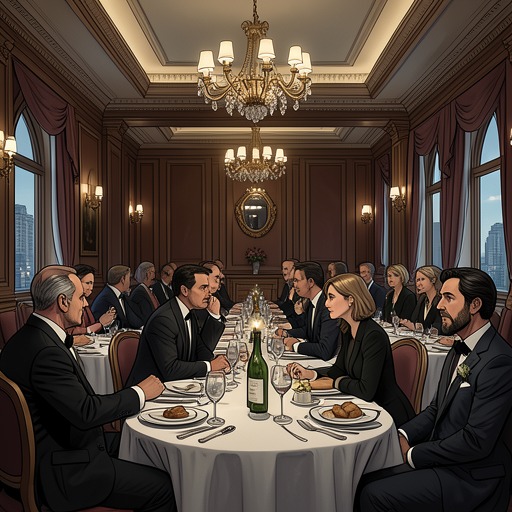
Tina is introduced as the editor of the Vernean Times, whose motto is “Eighty days is just the start.” She is described as exceptionally thin and dressed in jewelry that seems to outweigh her, a visual announcement of both status and self-display. Her professional position connects her to the same transnational travel-media culture that has made the Aurora Borealis voyage possible: she moves among editors, travel writers, photographers, and wealthy investors as if luxury were an occupational entitlement.
Her manner suggests that advancement in this world requires both charm and aggression. Tina crosses the room smoothly in a silver dress that rustles like snakeskin, greets Cole Lederer with kisses on both cheeks, and asks when he will complete a promised shoot for the Vernean. Cole answers with slight weariness, implying that their familiarity is established but not entirely comfortable. Tina’s warmth is therefore also a professional instrument: she maintains connections through intimacy, publicity, and the pressure of expectation.
Laura knows Tina partly through Rowan Lonsdale’s reputation. Office gossip presents Tina as a woman who rose by stepping over numerous younger women and then withdrawing the ladder once she had passed through the glass ceiling. Rowan characterizes her as someone who regards every other woman in the boardroom as a threat. This account does not prove that Tina is malicious, but it gives her a sharply competitive public image and helps Laura interpret even casual gestures as potentially strategic.
Social Performance aboard the Aurora Borealis
At the opening gathering, Tina abruptly turns her attention from Alexander Belhomme to Laura and invites Laura to talk about herself, addressing her as someone who works with Rowan. The question places Laura under scrutiny while pretending to offer welcome. Tina’s knowledge of Laura’s employment also demonstrates how quickly professional reputations circulate through the enclosed social world of the ship.
Tina advises Laura to enjoy the voyage and frames indulgence as a lesson in mortality, telling her that people live only once. The remark belongs to the ship’s culture of expensive pleasure, but it also carries an undertone of pressure: Laura is expected to accept the privilege being displayed rather than examine the people and arrangements that sustain it. The contrast is especially pointed because Laura has spent years reading Rowan’s reports from villas in the Bahamas and yachts in the Maldives, imagining that seniority would eventually grant her similar benefits. Once she receives a taste of that life, its distance from ordinary existence becomes more unsettling rather than less.
Tina’s own appearance repeatedly turns the social front of the voyage into a performance. She smokes beneath a curved glass shelter, wearing the posture of someone accustomed to being observed, and later appears in the spa without the elaborate presentation associated with the previous evening. Her setting changes from public deck to service space, but she remains legible as a woman managing an image. The ship’s luxurious guest areas and its cramped, windowless crew cabins form a stark material counterpart to her polished professional world: Tina belongs to the front stage, while the labor that makes that stage possible is largely hidden.
Wit, Drinking, and Gendered Competition
When Tina encounters Laura near the smoking shelter, she comments mockingly on how much Laura drank. She recalls advice from an earlier boss at the Express: being able to outdrink an interviewee was a route toward securing a first scoop. The anecdote makes drinking sound like a professional test, converting bodily endurance into journalistic competence and turning a social vice into a credential.
Laura’s memory of the office gossip surrounding Tina makes the exchange more complicated. Tina’s apparent lightness is backed by a career built within a male-dominated hierarchy, yet her success is represented as having produced hostility toward other women. The result is a form of gendered competition in which Tina has gained authority without becoming a source of uncomplicated solidarity. Her rings feel cool against Laura’s skin when she pats Laura’s arm, a small gesture that combines familiarity, wealth, and control.
Tina is also linked to Josef through Ben Howard’s claim that she had been with him. The information contributes to the ship’s dense network of concealed or disputed relationships, although the available evidence does not establish the circumstances or significance of the encounter. Tina’s relationship to Josef consequently remains part of Laura’s investigative uncertainty rather than a resolved explanation of the cabin 10 incident.
Suspicion during the Cabin 10 Incident
After the woman from cabin 10 disappears, Tina becomes one of the people Laura considers capable of having been near the scene. Ben’s poker game with Lars Jenssen, Archer Fenland, and Richard Bullmer leaves Laura with a comparatively small group of possible witnesses or participants, and Tina’s movements become relevant within that narrowed field. Laura watches her cross the salt-sprayed deck, noting her greyhound-thin body, narrow heels, and slight instability on the painted metal surface.
Laura asks herself whether Tina could have pushed a woman overboard. The question arises not only from physical speculation but from Rowan’s description of Tina as ruthless enough to compensate for her slight build. In this moment, Tina’s professional reputation becomes investigative evidence of a kind: the image of the relentless executive is translated into a possible capacity for violence. The transformation shows how unreliable testimony and social prejudice can operate together. Laura has no direct proof, but the narrative makes Tina suspicious because her public persona supplies a motive-shaped silhouette.
Tina’s ambiguity deepens because Laura later regards her as the best available chance of obtaining help. While Laura is confined and fears that she may be killed because she knows about Anne Bullmer and the deception surrounding Anne’s condition, she hopes Tina will contact Rowan if Laura fails to return. The odds seem very poor, but Tina’s position in the guest community gives her access to information and communication that Laura lacks. The same social power that makes Tina seem potentially dangerous also makes her one of Laura’s few possible links to the outside world.
The Bullmer Deception and Tina’s Limits
Tina is present within the social and commercial environment surrounding Richard Bullmer’s investment interests. She listens while Alexander discusses whether the investment structure is sustainable, whether the niche field will attract another backer, and whether Richard can afford to wait because Anne Bullmer possesses substantial wealth. Tina is therefore not merely decorative within the group: she is positioned as a professional listener and participant in conversations where money, reputation, and access are exchanged.
The deception involving Anne exposes the vulnerability of that entire social system. Anne is first presented as a visibly ill woman in a shapeless gray silk wrap, a scarf wound around her scalp, waxy pallor, and no eyebrows. Richard solicitously holds her arm as they leave the room, while her drawn, fine-boned face suggests illness and former beauty at once. Later, Laura sees a woman with the same dark eyes and high, jutting cheekbones but a radically different appearance, and finally understands that the voyage has involved a calculated impersonation. Richard had prohibited Cole from photographing Anne, not simply to spare her embarrassment but to prevent friends and relatives from comparing images afterward.
Tina’s role in this deception is not established as active participation. She belongs to the audience before which wealth, illness, marriage, and identity are performed, and her professional sophistication does not protect her from the performance’s success. Her position illustrates the power of visible signs: a headscarf, missing eyebrows, pallor, a bruise, and a protective husband’s gesture collectively make a story of illness credible. The later revelation turns those signs into evidence of manipulation without proving that Tina knew the truth.
Aftermath and Narrative Function
After Laura is rescued, Tina is among the people who sends a message through Judah Lewis. Her note, written in Judah’s list of contacts, says that she is very relieved Laura is safe and that Laura need not call back. The message is brief and restrained, but it confirms that Tina registered Laura’s disappearance and responded once Laura’s safety became known. It also distinguishes her from Ben, who leaves no message, and places her alongside Chloe Jenssen, who offers help through Lars.
Tina therefore ends the story neither as an exposed villain nor as a proven ally. She remains a figure of conditional usefulness: someone whose ruthlessness and status make her plausible as a suspect, but whose professional network also makes her a possible rescuer. Her final message does not erase Laura’s earlier doubts, because it offers no explanation of Tina’s movements during the disappearance and no direct account of what she knew. Instead, it preserves the novel’s wider concern with testimonial uncertainty. In the luxury world of the Aurora Borealis, appearances can conceal murder, illness can become a costume, and even a message of relief can reveal only the limits of what its sender is willing to say.
Tina’s narrative importance lies in that unresolved doubleness. She represents the competitive, image-conscious media establishment that Laura hopes to enter, yet she also shows the cost of surviving within it. Her jewelry, cigarettes, drinking lore, sharp professional contacts, and carefully managed social ease make her an emblem of class privilege and gendered ambition. At the same time, her thin body and apparently unsteady movement remind Laura that power is not always physical or transparent. Tina’s strength is institutional and reputational: it resides in whom she knows, what she can publish, and how convincingly she can perform authority. That makes her an effective mirror for the novel’s central problem—the difficulty of distinguishing genuine identity from the role a closed society has agreed to believe.